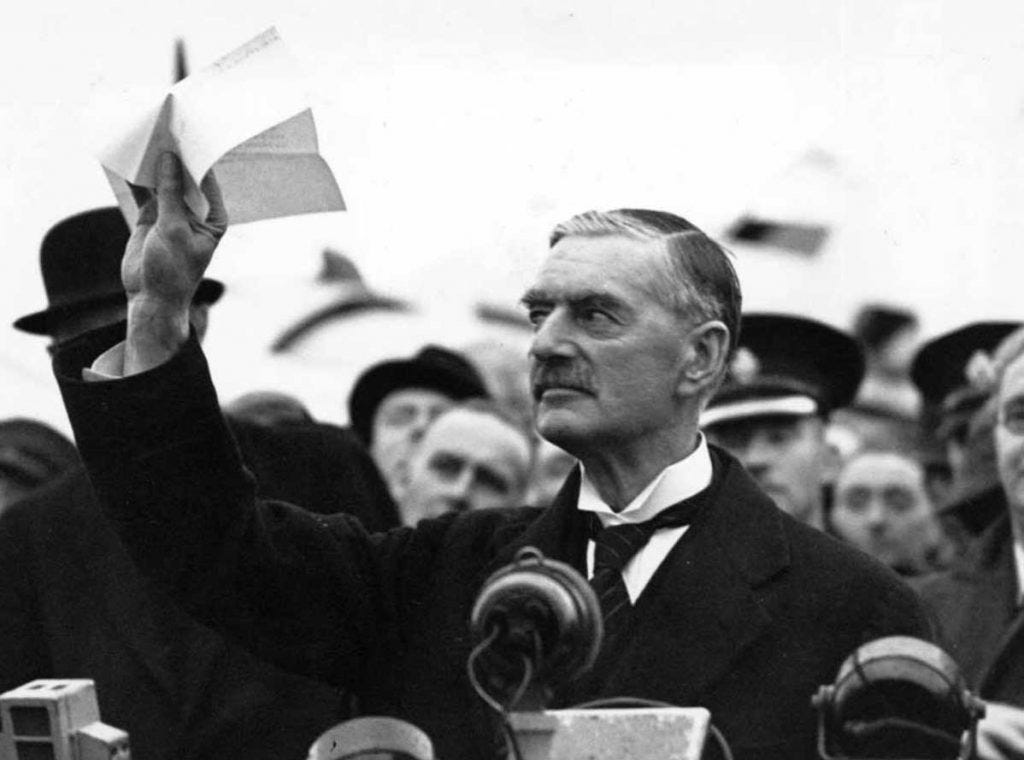
History has shown us time and again that appeasing dictators only emboldens them. The clearest example of this remains British Prime Minister Neville Chamberlain’s ill-fated policy toward Adolf Hitler in the 1930s. Convinced that war could be avoided through negotiation and concessions, Chamberlain famously returned from Munich in 1938 declaring “peace for our time” after allowing Hitler to annex the Sudetenland. Less than a year later, Hitler invaded Poland, and World War II began. Appeasement did not prevent war—it guaranteed it.
Fast forward to today, and we see eerily similar mistakes unfolding with Vladimir Putin’s war in Ukraine. The United States and its allies, despite early support for Ukraine, have begun to waver, with Washington appearing increasingly willing to grant Putin de facto control over parts of Ukraine in the hope of avoiding further escalation. This is not diplomacy; this is appeasement in real time. And just as it failed in 1938, it will fail again now.
The Munich Analogy: Weakness Invites Aggression
The logic of appeasement is based on a fundamental misunderstanding of authoritarian leaders. Those who argue for concessions believe that aggressors can be reasoned with, that they have a fixed set of demands, and that once satisfied, they will stop. But history shows the opposite: dictators view concessions as weakness, not goodwill.
When Chamberlain and French leaders gave Hitler the Sudetenland, they believed they were preventing war. Instead, Hitler interpreted their capitulation as a green light to take more. A year later, he seized the rest of Czechoslovakia. When the world still failed to act decisively, he concluded that he could invade Poland without serious consequences.
Today, the Trump administration risks making the same mistake by signaling to Putin that there are limits to U.S. support for Ukraine. U.S. Secretary of Defense Pete Hegseth has all but said Russia will get whatever it wants in order to end the war. Specifically, it is increasingly likely that a negotiated settlement would allow Russia to keep occupied territories—which mirrors Chamberlain’s naïve belief that sacrificing one country’s sovereignty would satisfy a dictator’s hunger for expansion. It won’t.
Putin Is Not Satisfied—And He Never Will Be
Like Hitler, Putin operates on an imperialist ideology. His speeches and actions make it clear that he does not simply want eastern Ukraine—he sees Ukraine as an illegitimate state and believes that much of the former Soviet Union rightfully belongs to Russia. If the West signals that it will not stop him in Ukraine, why wouldn’t he test NATO’s resolve in the Baltics or elsewhere?
We’ve seen this pattern before. In 2008, Putin invaded Georgia. The West issued statements but did little else. In 2014, he annexed Crimea. Again, the world largely let it happen. In 2022, he launched a full-scale invasion of Ukraine, believing—perhaps correctly—that Western resolve would eventually crumble. If we now force Ukraine to accept a ceasefire on his terms, what lesson does that teach? That aggression pays off.
The U.S. Is Risking a Repeat of 1939
The problem with appeasement is that it assumes peace can be secured without strength. It assumes that dictators can be pacified rather than deterred. But as history has shown, failing to confront aggression only encourages more of it.
If the U.S. pressures Ukraine to surrender land for "peace," Putin will not stop. He will see it as an invitation to push further, whether in Ukraine, Moldova, or even against NATO allies. Worse, other adversaries—China, Iran, North Korea—will take note. Just as Hitler watched the world’s weak response to Germany’s early aggression and concluded that he could take more, other authoritarian regimes will see a weak U.S. response to Ukraine as a signal that force is an effective tool for achieving their ambitions.
What Must Be Done
If we are to avoid repeating the mistakes of 1938, the solution is clear: Ukraine must receive full, unwavering support, and Putin must be decisively defeated. Half-measures will not work. Sanctions must be tightened, military aid must be unrestricted, and diplomatic pressure must remain strong.
This is not just about Ukraine. This is about ensuring that the world’s authoritarians do not believe that they can redraw borders by force without consequence. The failure to stop Hitler led to the most devastating war in human history. The failure to stop Putin now could lead to a similar catastrophe.
As Winston Churchill said in response to Chamberlain’s appeasement, “You were given the choice between war and dishonor. You chose dishonor, and you will have war.” The same choice stands before us today. It is time to choose wisely.